
He Opened the Wall to Find the Source of a Strange Smell and Was Stunned
The holes created in the siding needed to be addressed.
If they remained accessible, the woodpecker could simply return and begin the entire process again.
The openings were therefore patched, and the homeowner reportedly planned to install new vinyl siding.
This is a useful principle in many wildlife conflicts around homes.
Simply removing whatever is inside a structure doesn’t always solve the underlying problem.
If an animal still has access to the same opening—or if the feature that attracted it remains unchanged—it may return.
A lasting solution often involves changing the environment so the structure no longer offers the same opportunity.
In this case, closing the holes meant removing the bird’s access to the enormous hidden cavities.
The woodpecker could then seek a more appropriate location for its food-storage behavior.
The Bird Wasn’t the Villain
It would be easy to frame a story like this as a battle between a homeowner and a destructive animal.
But that misses one of its most interesting aspects.
The woodpecker wasn’t behaving maliciously.
It didn’t know the siding belonged to someone.
It didn’t understand construction, property boundaries, repair costs, or wall cavities.
It simply recognized a surface that could be used.
Wild animals make decisions based on survival opportunities.
Does this place offer shelter?
Can food be found here?
Is there somewhere to nest?
Can something valuable be stored safely?
Human buildings often accidentally answer “yes” to one or more of those questions.
An attic may resemble a protected nesting space.
A chimney can resemble a hollow tree.
A gap beneath a deck can provide shelter.
And, apparently, holes in siding can look like excellent places to hide acorns.
The conflict begins because the animal and homeowner assign completely different meanings to the same space.
Wildlife Is Remarkably Good at Adapting to Human Environments
This incident also illustrates something broader about wildlife.
Animals can be remarkably adaptable.
As towns, suburbs, roads, and homes expand into natural habitats, many species learn to take advantage of human-built environments.
Some birds nest on buildings.
Other animals use sheds, crawl spaces, roofs, garages, drainage systems, or landscaping for shelter and food.
These adaptations aren’t necessarily deliberate in the human sense.
Animals simply exploit opportunities that help them survive.
The California house offered the woodpecker an unusual opportunity: a surface into which it could place food and a vast hidden cavity behind it.
The bird couldn’t understand that the cavity belonged to a house.
It simply discovered something that appeared useful and continued using it.
That is what makes the story simultaneously funny, fascinating, and frustrating.
The same behavior that demonstrated remarkable persistence from the bird created an enormous cleanup job for humans.
Why 700 Pounds Changes the Entire Story
If Castro had opened the wall and discovered 20 acorns, this story probably wouldn’t have traveled very far.
Even a few hundred acorns would have been an interesting anecdote.
But approximately 700 pounds transforms the situation into something extraordinary.
Think about what that represents in individual trips.
A bird doesn’t transport hundreds of pounds of food at once.
It moves small amounts repeatedly.
The enormous final total therefore represents persistence over time.
Each delivery would have added almost nothing to the overall weight.
But those tiny additions continued until the accumulation became enormous.
It is a striking example of how repeated small actions can create surprisingly large results.
Nothing about a single woodpecker carrying an acorn looks dramatic.
Only when the wall is opened and the final accumulation is revealed does the scale become understandable.
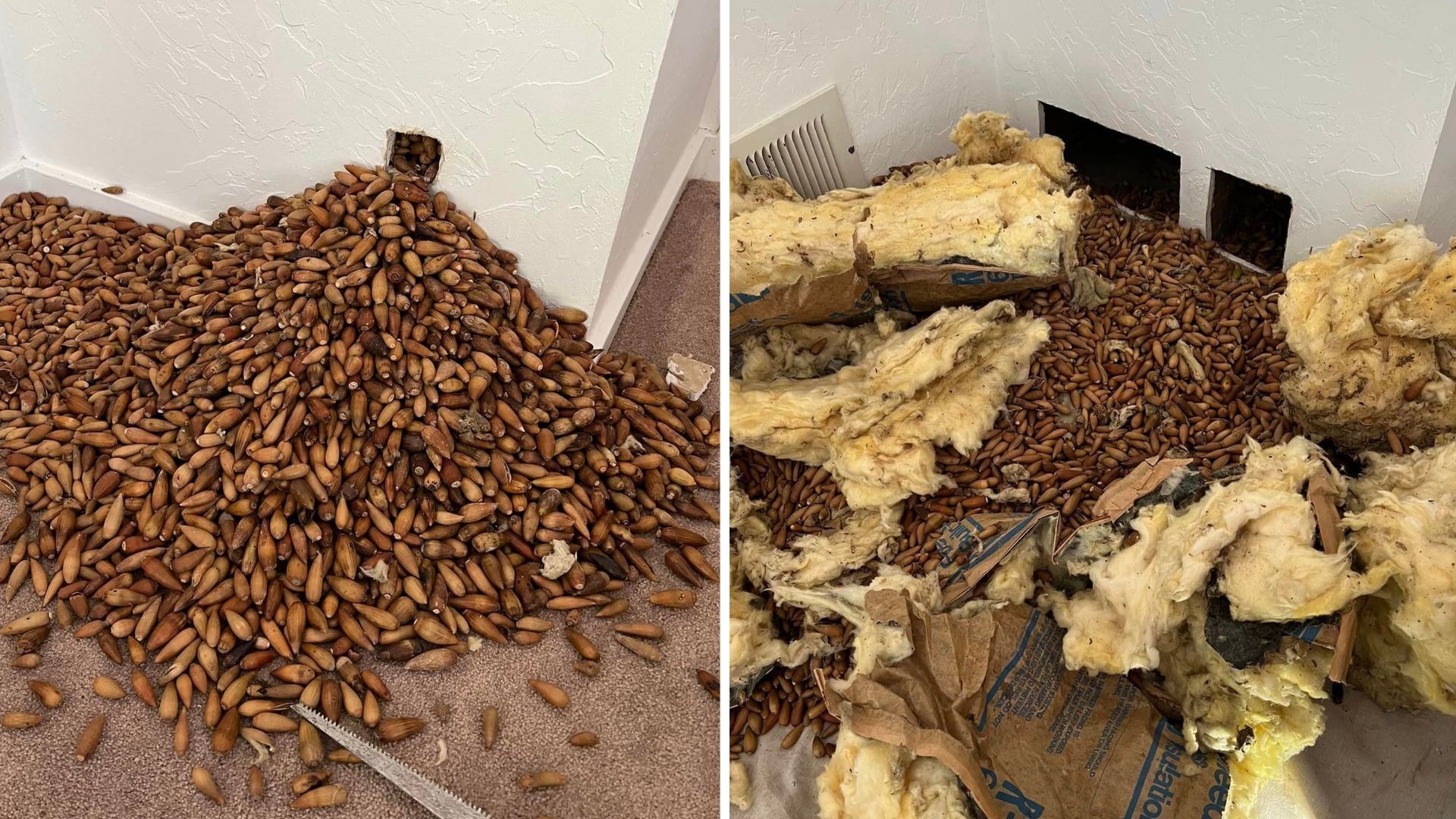
Please click the Continue Reading button below to keep reading.
Comments (0)